

If I Only Had $50: Getting Ready for the First 72 Hours
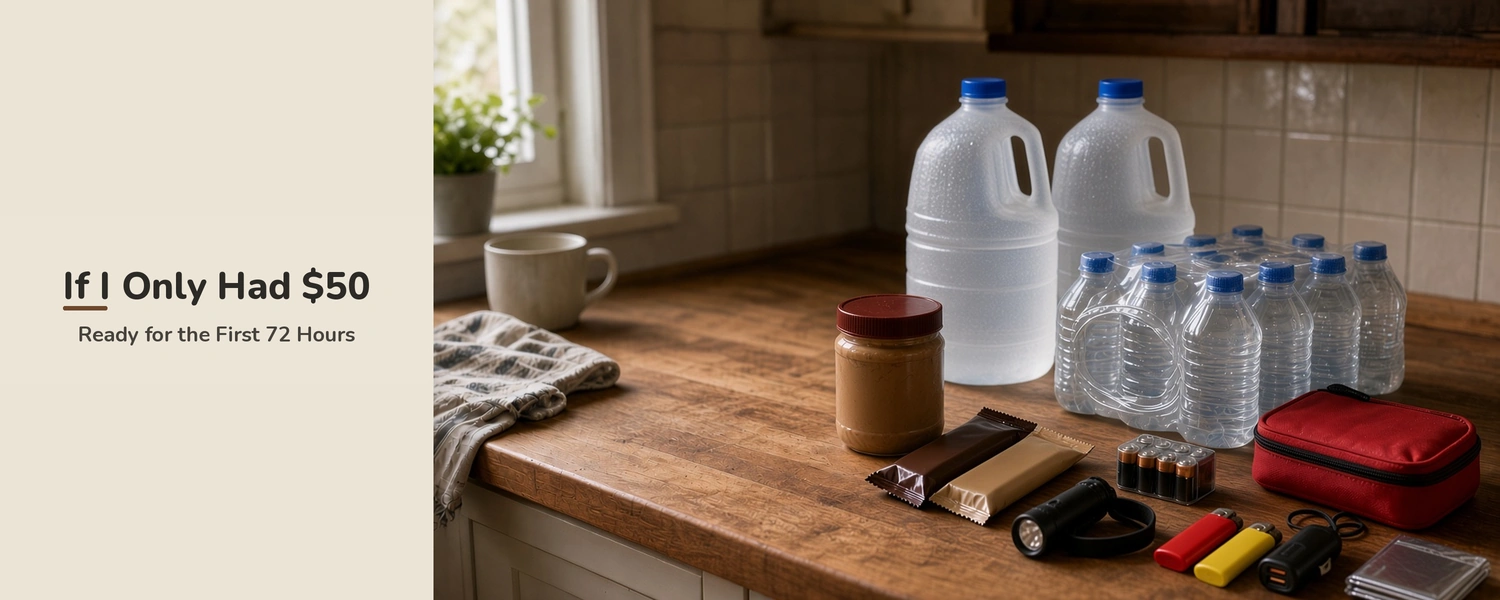
If I only had $50, I would spend it getting one person ready for the first 72 hours. That is the first priority: three days of water, food, light, a way to stay a little warmer, and a few basics for cuts and for charging a phone, whether I am staying home or have to leave for a short time.
This list is for one person, so the numbers stay clear. If more people are in the house, water and food are the main things that have to grow.
The cheapest way to get these items is usually a trip to a big box store, a dollar store, or another chain store. Places like Walmart, Dollar General, or Dollar Tree will typically save you money compared with buying each item separately online or at a specialty shop. You can often pick up most of this list in one stop, and store-brand versions of water, food, first aid, batteries, and lighters are usually enough. The prices below are average prices you can expect at stores like that. The sample total at the bottom lands at about $50.
Start with what you already have
Before buying anything, it helps to walk through the house and see what is already paid for. That is the point of our first article, "Where Do I Start? Check What You Already Have". A flashlight in a drawer, a jar of peanut butter in the pantry, a winter coat, or a basic first aid kit all count. Checking those off on the free checklist shows real progress and makes the actual gaps obvious.
Pay special attention to warm clothes if you already own them. A jacket, a hat, gloves, and a few pairs of good socks will do more for a cold 72 hours than most people expect. Those count toward Clothes For The Bag and Hot & Cold Weather Safety. This $50 list cannot also cover a new winter coat. If you do not have warm layers, look for a coat, sweater, hat, or wool blanket at a thrift store, a yard sale, or another second-hand shop.
The same goes for other gaps you cannot buy new at these prices. A used pot, a spare blanket, or a sturdy water jug from a thrift store can fill a hole without spending the whole $50. Buy only what you still need from the list below.
Water, about $5 to $8
For one person, the usual rule is 1 gallon per day, so plan on 3 gallons for 72 hours. Two 1-gallon jugs plus a 12-pack of bottled water gets you there. The jugs cover most of the volume at home, and the bottles are easier to carry if you have to leave.
Store-brand gallon jugs are often about $1.30 to $1.60 each, and a 12-pack of bottles is often about $3. Together that is commonly around $6, which sits in the $5 to $8 range. A full 24-pack plus two jugs can run a little over $8, so a 12-pack plus two jugs is usually the better fit for this budget. This is the 72 Hour Water Supply item on the checklist.
Food, about $10 to $15
Choose shelf-stable food that needs little or no heat: a jar of peanut butter, a box of energy or granola bars, and maybe crackers, tuna, or another no-cook item you will actually eat. A 16-ounce jar of peanut butter is often about $3 to $4, and a box of bars is often about $5 to $7, so $10 to $15 is enough for three days for one person. On the checklist, this belongs with Ready-to-eat food.
Pack food you already like. The first 72 hours are easier if the food does not feel like a last resort. If you already have peanut butter or snacks in the pantry, put that money toward whatever is still missing.
Light, about $8 to $10
A basic headlamp or flashlight lets you move around and handle small tasks if the power is out. A simple headlamp is often about $6 to $10, and some include batteries, which helps this budget. Hands-free light is useful at home and if you have to step outside after dark. This is the Flashlight and Headlamp item on the checklist.
Power: extra batteries and a car charger
If your light does not include batteries, or you want a spare set, a small 8-pack of AA or AAA batteries is often about $4 to $7 at a dollar store or chain store. Match the size to your light. This is the Extra batteries item on the checklist.
A USB car charger lets you charge a phone from a vehicle if the power is out at home. A basic one is often about $6 to $10. This is the Car Charger item on the checklist.
First aid, about $7 to $10
A small first aid kit covers cuts, burns, and basic care. A travel-size kit is often about $7 to $10 at a dollar store or chain store. This is the First Aid Kit item on the checklist.
If you already have a kit at home, check the dates on the ointments and add a few bandages instead of buying a second kit.
A lighter
A couple of pocket lighters take almost no space and give you a way to light a candle, a stove, or a grill if you have one. A 2-pack is often about $3 to $4 at a dollar store or chain store. This is the Lighters, matches and ferro rod item on the checklist.
A Mylar blanket
A Mylar emergency blanket is light, inexpensive, and helps hold body heat if the house gets cold or you have to wait somewhere without heat. It is not a substitute for the warm clothes you already own, but it is a good backup. A small pack of two to four is often about $6 to $8. This is the Mylar blanket item on the checklist.
A sample $50 total
Here is one way the list can land at about $50 for one person, using average prices. Your store may vary a little.
- Water: two 1-gallon jugs and a 12-pack of bottles — $6
- Food: peanut butter and no-cook snacks — $10
- Light: basic headlamp or flashlight — $8
- Extra batteries, small AA or AAA pack — $4
- Small first aid kit — $7
- Pocket lighters, 2-pack — $3
- Mylar emergency blanket pack — $6
- USB car charger — $6
- Sample total — $50
If more than one person is in the house
This estimate is for one person, so the numbers stay clear. Each extra person needs more water and food especially: about 1 gallon of water per person per day, and more no-cook food for three days. A second person is roughly another 3 gallons of water and another $10 to $15 of food.
Light, the first aid kit, the lighter, the car charger, and even a pack of Mylar blankets can often be shared, though a second blanket is a good idea if you can. Warm clothes should be checked person by person. What you already own still comes first.
Use the free checklist
Work through the free checklist at https://preparednesschecklist.com. A free account saves your progress, including what you already have and what you still need.